
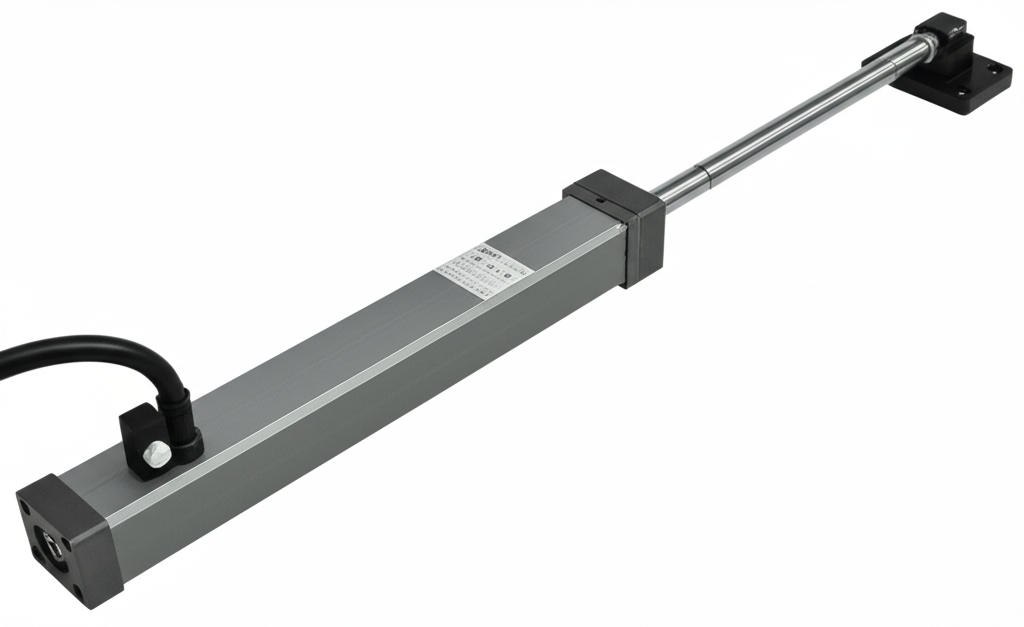
Mastering Precision Motion: The Long Stroke Electric Actuator with Position Feedback
Do you ever want to move something big and heavy with just one finger? Does your job need you to push, pull, or lift things with perfect accuracy, but you keep running into problems? Maybe you’re an engineer, a technician, or you run a busy factory. Whatever the case, you know that in your business, getting things just right makes all the difference. You’ve tried hydraulics and pneumatics. They leak, they’re noisy, they’re hard to control, and you’re always worrying about maintenance.
That’s the struggle: you need strength, speed, and—most of all—precision. Imagine fighting with a clunky machine every time you want something to line up or move in a straight line. Imagine wasting hours troubleshooting errors, slowing down your whole line, or sending reject after reject down the conveyor. There’s got to be a way that’s smarter, cleaner, quieter, and a whole lot more reliable.
Those cabinets that need a ladder.
That desk that only knows two positions: stuck and unstuck.
That conveyor belt that sort of knows where it should stop but never really does.
Manual headaches, wasted time, and endless searching for something better.
But what if there was a way to make everything move exactly where you want, every single time? Enter the world of long stroke electric actuators with position feedback.
The Smart Solution: Bringing Motion Under Control
A long stroke electric actuator with position feedback is your ticket out of the guesswork. It’s a simple idea—an actuator is just a device that moves things. But when you power it electrically, make it travel very far (long stroke), and add position feedback, you get next-level control.
Let’s break it down:
- Electric actuator: It converts electricity into precise linear motion.
- Long stroke: It can push, pull, or lift objects over a wide range—from 100 mm up to several meters!
- Position feedback: It knows exactly where it is at all times. Encoders, potentiometers, LVDTs, or Hall effect sensors feed information back to the controller, keeping everything on target.
When you bring these together, you don’t just get strength or speed. You get a closed-loop electric actuator. The system watches itself, checks itself, and corrects itself in real time. That means no drifting, no overshooting, no more stops in the wrong place. Your equipment moves with repetibilidad y accuracy—sometimes as tight as 0.01 mm.
How Does It Work? Let’s Peek Inside
You push the button. The motor kicks in. That’s your servomotor, brushless DC motor, or even a good old AC induction motor. Each one’s got its perks—servo for best precision, stepper for simple jobs, BLDC for quiet and efficient motion.

The motor’s spinning shaft meets a drive mechanism—usually a ball screw, roller screw, or lead screw. Think of it like a twisty path that changes spinning into straight pushing. Ball screw and roller screw are your heavy hitters for long travels and big forces. Lead screws are affordable if you don’t need a ton of power.
Next, the position feedback system steps in:
- Encoders: Optical, magnetic, incremental or absolute, tell you where you are in numbers.
- Potentiometers: Cheap, basic, good enough for many jobs.
- LVDTs: Super accurate, never tired, keep your process rock solid.
- Hall effect sensors: No touch, no wear, just reliable signals.
The feedback lets the actuator’s controller know exactly where things are—no more guessing. You program the move, the actuator follows, and the feedback keeps everything honest. If something slips, the system catches it and corrects.
Why Choose Electric Actuators Over Hydraulics or Pneumatics?
Time for the real payoff. Let’s talk about the benefits.
1. Unbeatable Precision & Repeatability
You want every motion to match your blueprints. These actuators hit sub-millimeter accuracy across millions of moves. You close your eyes and trust your machine—no more second checks, no more measuring twice.
2. Energy Efficiency
Old-school hydraulics and pneumatics waste power—sometimes only 20–40% efficient, compared to up to 90% for electric. That means running costs go down. If you’re watching your bottom line (who isn’t?), this is a win.
3. Cost Savings & Low Maintenance
No fluids, hoses, or leaky pumps. No air compressors whirring away. Just wires and metal, running clean and quiet. You might see up to 70% maintenance cost reduction compared to the old systems. Your machines last longer too—some actuators keep going for 100 million cycles.
4. Superior Control & Flexibility
You control speed, acceleration, deceleration, and position—all programmable. You plug into PLCs, HMIs, and networks like Ethernet/IP, PROFINET, o EtherCAT. No limits. Need to change something on the fly? Easy.
5. Cleaner, Quieter, and Safer Operation
Electric actuators don’t yell. They whisper. Many run under 70 dB(A), perfect for sensitive environments. High *Clasificación IP, up to IP69K, handle washdowns and dust. Built-in safety features like STO y SS1 keep everything secure. You get diagnostics and predictive maintenance to catch problems before they grow.
What Can You Do With Them? Applications That Matter
The sky’s the limit. Here’s how companies change the game:

- Manufacturing & Factory Automation: Move, sort, and assemble with conveyor diverters, sorting machines, gantry robots, and precision pressers. Packaging lines use them for filling, capping, and carton making—seeing up to 15% faster throughput y fewer rejects.
- Medical & Pharmaceutical: Position patients gently, automate labs, and ensure super-clean performance in cleanrooms.
- Energy Sector: Solar panel tracking systems rely on actuators for up to 30% more energy yield each day.
- Specialty Uses: Automated test rigs in automotive, stage magic in entertainment, and flight simulators all trust these actuators. When you need big, precise, and reliable moves, nothing beats them.
Want even more? Explore our Cilindros eléctricos y Sistema de actuador lineal de carrera larga y alta velocidad for details and solutions.
What Should You Look For When Choosing Yours?
Buying the right long stroke electric actuator with position feedback needs planning. Think about:
- Stroke Length & Force: How far does it need to go? A little (100 mm) or a lot (3000 mm+)? How much weight does it move—light plastics or heavy steel?
- Speed, Acceleration, & Duty Cycle: Does it move fast and often—or slowly and rarely? Can it handle continuous work, or does it get breaks in between?
- Position Feedback Type & Resolution: What accuracy do you need? Pick your sensor: encoder, potentiometer, LVDT, or hall effect. Consider your environment too.
- Environmental Needs: Dusty plant floor, wet food line, or sterile medical bay? Choose proper IP, NEMA, o ATEX ratings.
- Motor & Drive Compatibility: Will it fit your control system—Modbus, CANopen, or something else?
- Mounting & Mechanical Integration: Mounting brackets and special rails keep the system locked in place. See our Guías lineales y raíles for more help.
Jimi Technology: Trusted Partner for Smart Motion
Nosotros en Tecnología Jimi have seen every kind of automation challenge. Our team doesn’t just sell electric actuators—we help you solve problems. We build each system using top-grade motors, super-tough ball screws, and the latest position sensing technology. Every product comes backed by our deep experience, serious manufacturing strength, and eyes for detail. With our help, you skip the headaches and move straight to smooth automation.
Need controllers, accessories, or help setting it up? Check our Controladores de actuadores and complete Sistemas de movimiento lineal for whatever you need.
Our automation experts stand ready. Whether you want to turbocharge your line accuracy, build a quiet medical device, or max out solar panel yield, we’re here. We make integration easy, saving you up to 30% setup time compared to traditional fluid power.
Looking Ahead: Innovation on the Move
Industry 4.0 isn’t a buzzword—it’s happening now. We put actuadores inteligentes into your hands, ready for IIoT with real predictive maintenance, quick connectivity, and smarter control. Our next-gen designs offer more power in less space, so when your project grows, your actuator matches it step for step.
Summary Table: Key Specs and Benefits
| Característica | Value / Range | Beneficio |
|---|---|---|
| Longitud de la carrera | 100 mm to >3000 mm | Fits any long travel need |
| Force Output | 50 N to 250 kN | Handles light or heavy loads |
| Velocidad | 10 mm/s to 1.5 m/s | Fast or slow applications |
| Repetibilidad | ±0.01 mm to ±0.05 mm | Super-accurate moves |
| Life Cycle | 5M to >100M cycles | Less downtime, more savings |
| Energy Conversion | 80-90% | Big power savings |
| Maintenance Cost | Up to 70% lower | Less fixing, more working |
| Noise Level | <70 dB(A) | Quieter environments |
| Clasificación IP | Up to IP69K | Works in tough conditions |
Ready to Move Smarter?
When you want every move to be perfect, fail-safe, and easy, choose Tecnología Jimi for your long stroke electric actuator with position feedback. Turn your motion chaos into clear, managed power. Browse our China Electric Cylinder Factroy, discover the best Actuadores lineales, and get support from industry leaders.
Contact our experts now. Let’s build your next automation success—no more guessing, no more hassle, just pure precision every time.




 English
  Arabic
  Russian
  Spanish
  French
  Japanese
  Korean
  German
Deja un comentario