

Powering Precision: How Linear Actuators and Slewing Drives Drive Modern Solar Tracking Systems
Introduction
In the rapidly evolving renewable energy landscape, solar tracking systems have become indispensable for maximizing photovoltaic (PV) and concentrated solar power (CSP) efficiency. Unlike fixed installations, a solar tracker dynamically adjusts the orientation of solar panels to follow the sun’s trajectory, boosting energy yield by 20% to 40% depending on geographic location and tracking architecture. At the mechanical heart of every solar tracking system lies a carefully selected power unit—typically electric linear actuators for tilt adjustments and slewing drives (rotary actuators) for azimuth rotation. This article explores how these distinct actuation technologies serve as the muscle behind single-axis, dual-axis, and concentrated solar thermal trackers, with concrete product examples illustrating their integration.
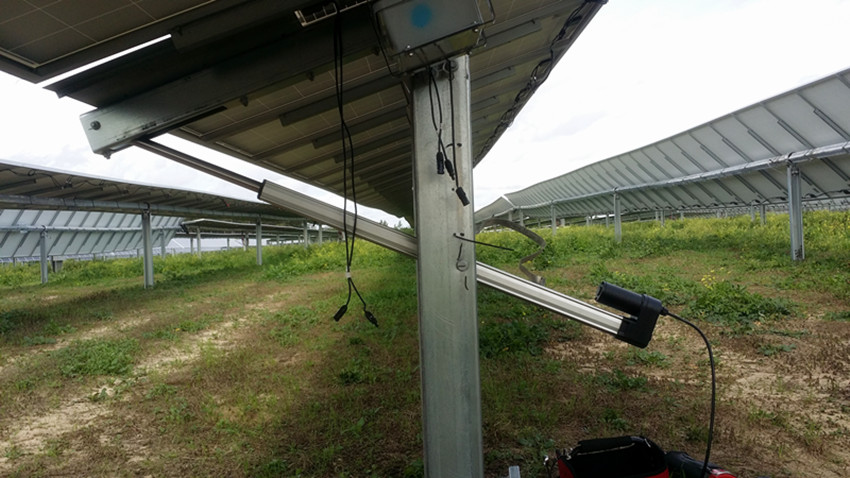
Single-Axis Trackers: The Workhorse of Utility-Scale PV
Single-axis solar trackers represent the dominant architecture in utility-scale deployments due to their favorable balance of energy gain and cost. These systems rotate panels along one degree of freedom—typically the North-South axis—to track the sun’s east-west movement (azimuth tracking). The power unit of choice for horizontal single-axis trackers is the slewing drive, a sealed gearbox assembly that combines a worm gear, slewing bearing, and electric motor into a single robust unit.
Slewing drives excel in single-axis applications because they simultaneously support axial loads, radial loads, and tilting moments while delivering precise rotational torque. For example, the VH7 vertical slewing drive manufactured by Hostboks is engineered specifically for 60–80 panel horizontal single-axis arrays, delivering an output torque of 6.3 kN·m with a holding torque of 45 kN·m and IP65 protection for 25-year field life. Its hourglass worm design provides multi-tooth contact, ensuring high rigidity and self-locking capability that eliminates the need for additional braking mechanisms during high-wind events. Similarly, the SC9 slewing drive from Coresun Drive is optimized for 12–16 panel configurations, offering a gear ratio of 61:1 and compatibility with 24V DC, 220V AC, or 380V AC motors, making it adaptable to diverse project scales and electrical standards.
In tilted single-axis trackers—preferred for latitudes above 40 degrees where seasonal elevation angles vary significantly—slewing drives are mounted at the torque tube pivot points. The SE9 slewing drive from XZWD exemplifies this application, providing enclosed housings with double-lip rotary shaft seals to withstand dust, moisture, and temperature extremes from -30°C to +70°C. These drives rotate the entire panel row through ±45° to ±60° tracking ranges, with precision under 0.1°, ensuring panels maintain optimal incidence angles throughout the day.

Dual-Axis Trackers: Maximizing Energy Capture with Hybrid Actuation
For installations where maximum energy density is paramount—such as high-latitude regions, concentrated photovoltaics (CPV), or solar thermal power plants—dual-axis solar trackers track both azimuth (horizontal rotation) and elevation (vertical tilt). This full-tracking approach can increase power generation by over 35% compared to fixed mounts, but it demands a more sophisticated actuation strategy combining both slewing drives and linear actuators.
The predominant dual-axis design employs a slewing drive for azimuth rotation at the base of the main mast, while an electric linear actuator handles elevation adjustment. The slewing drive bears the entire weight of the array and withstands wind-induced overturning moments, whereas the linear actuator provides the precise linear push-pull motion needed to tilt the panel frame. According to engineering research from the Norwegian University of Science and Technology, this hybrid configuration allows the azimuth axis to rotate approximately 280–310° while the elevation axis achieves 0–60° pitch movement, completely following the sun’s daily and seasonal arc.
A compelling commercial example is the BOFU Mini Dual-Axis Solar Tracker, designed for residential or small agricultural applications with 2–6 solar panels. This system utilizes a slewing bearing drive for horizontal rotation (±90°) and a linear actuator with 2000N thrust for elevation control (0–60°). The controller calculates real-time sun position via astronomical algorithms and GPS, commanding both actuators to synchronize panel orientation. At night, the linear actuator returns panels to a flat stow position, reducing wind exposure and soiling accumulation. The entire assembly weighs only 90 kg and achieves IP56 waterproofing by concealing the slewing motor inside the lower column—a design that demonstrates how compact hybrid actuation can democratize dual-axis tracking for distributed generation.
For larger commercial and industrial dual-axis systems, the SVH3 dual-axis slewing drive from Coresun Drive integrates both azimuth and elevation actuation into a single assembly. This 3-inch precision unit delivers 716 N·m output torque with ≤0.2° accuracy, utilizing patented hourglass worm technology for self-locking and backlash control. Such integrated drives are particularly valuable for CPV and solar dish concentrator applications where sub-degree tracking precision is mandatory to maintain focal alignment.
Concentrated Solar Thermal (CSP) and High-Precision Applications
Beyond conventional PV, solar tracking systems play a critical role in concentrated solar thermal (CSP) plants and concentrated photovoltaic (CPV) systems. These technologies require exceptional tracking accuracy—often within ±0.1°—because the concentrator must precisely focus sunlight onto a receiver or multi-junction cell. In such scenarios, slewing drives with high reduction ratios and zero-backlash designs become essential.
The VH9 vertical slewing gear motor offers a 61:1 gear ratio with 6,405 N·m output torque and 56 kN·m holding torque, making it suitable for large parabolic troughs and solar dishes weighing several tons. Its 42CrMo alloy steel construction and dual-layer epoxy zinc-rich powder coating provide C3–C5 corrosion resistance for desert and coastal environments where CSP plants are commonly sited. For heliostat fields in central tower CSP plants, arrays of smaller slewing drives—such as the SE7 enclosed slewing drive—enable individual mirror control, allowing each heliostat to track the sun independently and redirect flux onto the central receiver with milliradian precision.
Control Integration: The Brain Behind the Muscle
Regardless of actuator type, modern solar trackers rely on intelligent control systems to orchestrate movement. Controllers typically employ 32-bit MCUs running astronomical algorithms that calculate sun position based on GPS coordinates, date, and time. These open-loop commands are often augmented by closed-loop feedback from light sensors or rotary encoders integrated into the slewing drives and linear actuators.
Communication infrastructure has also evolved. The SAST single-axis tracking system from Kseng Energy features RS485 Modbus protocol for actuator command distribution, with optional Bluetooth, Wi-Fi, or 4G connectivity for remote monitoring. Wind sensors trigger automatic stow protocols—slewing drives return arrays to neutral positions while linear actuators flatten dual-axis panels—protecting mechanical components from survival wind speeds exceeding 37 m/s. Night return modes ensure panels face east before dawn, eliminating morning energy loss during tracker reorientation.
We think
The evolution of solar tracking systems is inextricably linked to advances in actuation technology. Slewing drives dominate single-axis and azimuth applications by delivering high torque, load-bearing capacity, and maintenance-free longevity in sealed housings. Linear actuators provide the precise, energy-efficient linear motion essential for elevation control in dual-axis and small-scale trackers. Together, these power units enable solar trackers to transform passive panel arrays into dynamic energy-capture machines, pushing PV and CSP efficiency to their theoretical limits. As the global demand for clean energy accelerates, the synergy between robust mechanical actuation and intelligent control will continue to define the next generation of solar panels tracker technology.

Leave A Comment