

In today’s rapidly evolving industrial landscape, precision and efficiency are paramount. Linear guide modules, also known as linear guide modules or linear motion systems, have become indispensable building blocks across a wide spectrum of industrial equipment and robotic applications. These integrated mechanical systems combine a linear guider rail, ball screw or belt drive, and a motorized carriage into a single, compact unit, delivering repeatable and accurate linear motion with minimal friction. This article explores the diverse application scenarios of linear guide modules in industrial machinery and robotics, highlighting their critical role in driving automation forward.
1. CNC Machine Tools and Precision Machining
One of the most traditional yet vital applications of linear guide modules is in Computer Numerical Control (CNC) machine tools. Whether in milling machines, lathes, or grinding equipment, linear motion systems provide the backbone for axis movement. Heavy-duty linear rails integrated into linear guide modules ensure that cutting tools traverse workpieces with micron-level accuracy. The rigidity and load-bearing capacity of these modules directly influence surface finish quality and dimensional tolerances.
Modern CNC lathes, for example, employ cross-axis linear guider systems to position the tool turret precisely along the X and Z axes. The low-friction characteristics of recirculating ball guides within these modules reduce heat generation during high-speed operation, while their preload capabilities eliminate backlash, ensuring consistent machining performance even under heavy cutting loads.
2. Industrial Robotic Arms and Cartesian Coordinate Systems
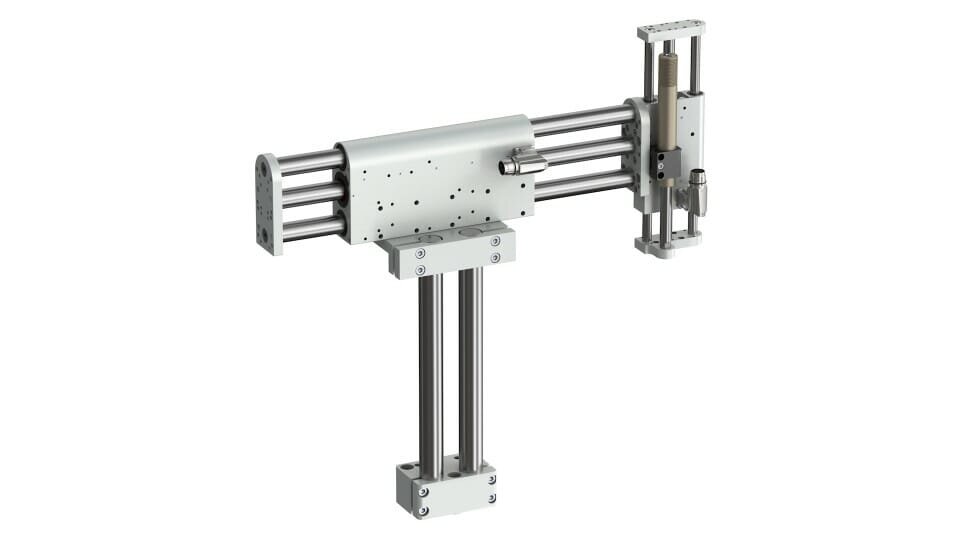
Industrial robots, particularly Cartesian (gantry) and SCARA-type systems, rely extensively on linear guide modules to achieve multi-axis positioning. In pick-and-place operations, packaging lines, and assembly stations, XYZ gantry configurations built from individual linear motion modules create three-dimensional workspaces where end-effectors can reach any point with high repeatability.
A typical gantry robot uses one linear guide module for the base X-axis, a second mounted perpendicular for the Y-axis, and a vertical module for the Z-axis. This modular approach allows engineers to customize stroke lengths and payload capacities to match specific application requirements. Belt-driven linear modules are often preferred for long-stroke, high-speed horizontal movements, while ball screw-driven modules excel in vertical axes where holding torque and precision are critical.

3. Automated Welding and Fabrication Systems
In automated welding applications, linear guide modules serve as the positioning mechanism for welding torches, plasma cutters, and laser cutting heads. Multi-axis welding robot arms utilize linear motion modules to traverse large workpieces while maintaining a consistent torch angle and standoff distance. The smooth, vibration-free motion provided by quality linear guider systems is essential for producing uniform weld beads and preventing defects.
Aluminum-profile linear guide modules are particularly popular in welding automation due to their lightweight yet rigid construction. These modules can be configured into H-gantry or cantilever systems to cover large welding envelopes, often exceeding several meters in length. Integrated cable carriers and protective covers ensure reliable operation in harsh environments filled with sparks, spatter, and heat.
4. Semiconductor and Electronics Manufacturing
The semiconductor industry demands extreme precision and cleanliness, making linear guide modules with specialized designs essential for wafer handling, chip inspection, and die bonding equipment. In these environments, linear motion modules must deliver sub-micron positioning accuracy while operating in cleanroom conditions. Stainless steel or anodized aluminum constructions with sealed bearing systems prevent particulate contamination.
Automated optical inspection (AOI) machines use XY linear guide module stages to scan printed circuit boards (PCBs) and semiconductor wafers at high speeds. The linear guider rails in these systems often feature crossed-roller bearings instead of ball bearings to achieve higher stiffness and better geometric accuracy. Additionally, ironless linear motor-driven modules are increasingly adopted in semiconductor equipment for their zero-cogging motion and exceptional dynamic response.
5. 3D Printing and Additive Manufacturing
The additive manufacturing revolution has brought linear guide modules into desktop and industrial 3D printers alike. FDM (Fused Deposition Modeling) printers rely on linear motion systems to move the print head along X and Y axes while the build platform moves along Z. The precision of these linear guide modules directly impacts layer alignment and overall print quality.
High-end 3D printers and CNC routers utilize enclosed linear guide module designs with ball screw drives to achieve the rigidity needed for machining composites and metals. CoreXY and H-bot kinematic systems, popular in large-format 3D printers, use a network of linear guider rails and timing belts to translate motor rotation into coordinated toolhead movement. The low maintenance requirements and long service life of modern linear motion components make them ideal for continuous production environments.
6. Medical and Laboratory Automation
In the medical device and laboratory automation sectors, linear guide modules enable precise liquid handling, sample processing, and diagnostic equipment operation. Automated pipetting robots, for instance, use compact linear motion modules to position dispensing heads over microplate wells with 0.1 mm accuracy. The quiet, smooth operation of low-noise linear guide modules is particularly important in clinical settings where vibration and acoustic noise must be minimized.
Medical imaging equipment, such as CT scanners and MRI patient tables, also employs heavy-duty linear guider systems to move patients smoothly and safely into the imaging bore. These modules must meet stringent safety standards and often incorporate redundant braking systems and position feedback encoders to ensure fail-safe operation.
7. SCARA and Collaborative Robots
While SCARA (Selective Compliance Assembly Robot Arm) robots are primarily rotary joint systems, many modern designs incorporate linear guide modules as vertical Z-axis lifts to extend their reach and payload capacity. This hybrid approach combines the speed and flexibility of rotary joints with the precision and extended stroke of linear motion. Similarly, collaborative robots (cobots) increasingly use linear axis modules to expand their workspace beyond the reach of a fixed-base arm.
In electronics assembly, SCARA robots with integrated linear guide module Z-axes can pick components from feeders at varying heights and place them onto PCBs with exceptional accuracy. The linear motion component provides the rigid, backlash-free vertical movement needed for delicate component placement without damaging leads or solder joints.
8. Material Handling and Conveyor Systems
Beyond robotic arms, linear guide modules are fundamental to automated storage and retrieval systems (AS/RS), palletizing robots, and sorting equipment. In warehouse automation, linear motion modules drive the horizontal and vertical movement of shuttle vehicles that retrieve inventory from high-density racks. Belt-driven linear modules with long strokes—sometimes exceeding 10 meters—are engineered with high-tension steel cords to prevent elongation and maintain positioning accuracy over time.
Palletizing robots use vertical linear guide modules to adjust gripper height while rotary actuators handle orientation. The combination of linear and rotary motion creates a cylindrical coordinate system that is highly efficient for stacking and destacking operations in logistics centers.
Key Selection Parameters for Linear Guide Modules
When integrating linear guide modules into industrial or robotic applications, several critical parameters must be evaluated:
- Stroke Length: The total travel distance required, which determines module sizing and drive type (ball screw vs. belt).
- Load Capacity: Both static and dynamic load ratings must accommodate the payload plus any external forces.
- Accuracy and Repeatability: Positioning accuracy (±0.01 mm to ±0.001 mm) and bidirectional repeatability specifications.
- Speed and Acceleration: Belt-driven modules typically achieve 2–5 m/s, while ball screw modules are limited to 0.5–1.5 m/s.
- Environmental Protection: IP ratings, sealing options, and material choices for dusty, wet, or cleanroom environments.
- Motor Integration: Stepper, servo, or linear motor compatibility with the control architecture.
Conclusion
From the precision demands of semiconductor fabrication to the rugged requirements of automated welding, linear guide modules have proven themselves as versatile, reliable, and essential components in modern industrial automation and robotics. As a linear guider system, linear motion enabler, and linear guide module platform, these devices continue to evolve with advances in materials, drive technologies, and smart control integration. For manufacturers and system integrators seeking to enhance productivity, accuracy, and flexibility, investing in high-quality linear motion solutions remains one of the most impactful decisions in machine design.



Leave A Comment