

How to Select the Right Servo Linear Actuator: A Complete Guide Based on Thrust and Speed Requirements
Choosing the correct linear motion solution can be overwhelming. With so many products on the market—ranging from a compact mini linear actuator to heavy-duty industrial systems—buyers often struggle to match their performance requirements with the right technology. The two most critical parameters are thrust (force) and speed. This guide will walk you through the selection logic step by step, from low-speed DC actuators to high-speed precision sliding module systems, so you can avoid overpaying or under-specifying your equipment.
Tier 1: Low Speed, Moderate Force — DC Linear Actuators (up to ~2 mm/s)
If your application requires a thrust of around 2000N at a speed of 2 mm/s or below, a standard DC electric linear actuator is almost always the best choice. These actuators typically run on 12V or 24V DC power and use a brushed or brushless motor driving a trapezoidal (ACME) screw through a gearbox.
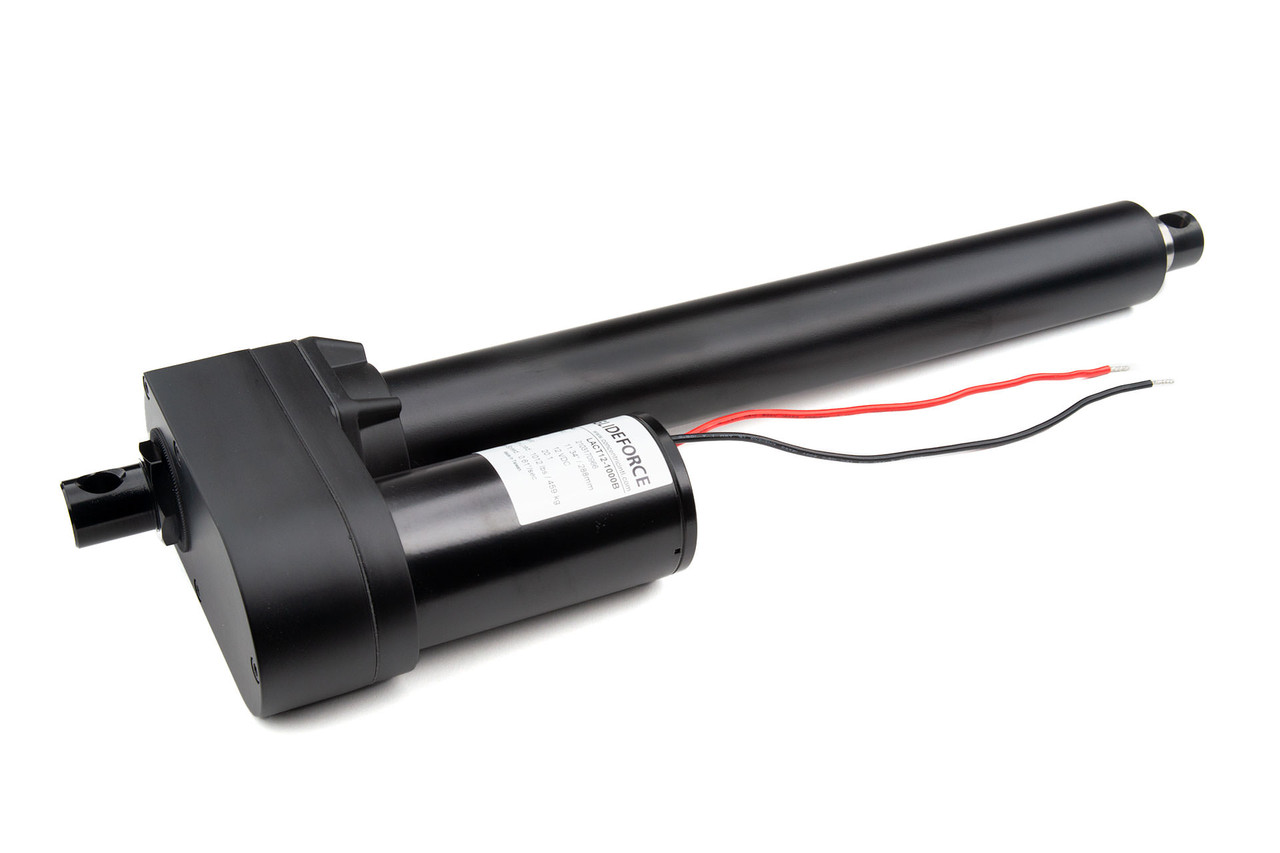
A typical mini linear actuator in this category offers several distinct advantages. First, DC power means you can integrate them directly into battery-powered or vehicle-based systems—think solar trackers, agricultural machinery, hospital beds, or recliner chairs. Second, they are compact, sealed (many carry IP65 or IP66 ratings), and require virtually no maintenance. Third, they are remarkably cost-effective; a quality 2000N unit costs a fraction of what an equivalent industrial system would.
The trade-off is speed. Because the gear ratio must be high to generate 2000N of push force from a small DC motor, the output speed stays low—usually between 1 and 5 mm/s. For applications like height adjustment, window opening, or valve control, this is perfectly adequate. Just remember the golden rule: keep DC actuators at 2 mm/s or below when pushing near their rated 2000N capacity, or the motor will overheat and the screw will wear prematurely.

Tier 2: Medium Speed, Higher Duty — AC Electric Linear Actuators (5 mm/s and above)
Once your speed requirement climbs above 5 mm/s, DC technology starts to hit its limits. At these speeds, the motor must spin far faster to deliver the same force, and the small DC commutators simply cannot dissipate the heat generated. This is where an AC electric linear actuator takes over.
AC actuators use a single-phase or three-phase induction motor, which is fundamentally better suited for continuous high-speed operation. These motors tolerate sustained loads, run cooler, and integrate seamlessly with industrial power supplies. AC linear actuators commonly deliver speeds in the 5–20 mm/s range with thrusts from 500N up to 10,000N or more.
Typical applications include industrial door systems, conveyor tensioning, damper control, and material handling equipment. The caveat is that AC actuators are larger, heavier, and usually more expensive than their DC counterparts. They also require mains power, making them unsuitable for mobile or battery-powered equipment. When you see the term fast linear actuator in industrial catalogs, it most often refers to this AC-powered category.
Tier 3: High Speed, High Force — Electric Cylinders (20 mm/s and above)
If your speed requirement exceeds 20 mm/s, screw-driven actuators with standard trapezoidal threads are no longer efficient. At this point, you must upgrade to an electric cylinder powered by a servo motor and a precision ball screw.
The ball screw is the key differentiator. Unlike trapezoidal screws, ball screws convert rotary motion to linear motion through rolling balls rather than sliding friction. This delivers three major benefits:
- Efficiency above 90% — meaning more of the motor’s power becomes thrust, and less becomes waste heat
- Speeds of 20–500 mm/s or higher while still pushing thousands of newtons
- Precision positioning — ball screws are manufactured to tight tolerances, giving repeatable positioning within ±0.02 mm when paired with a servo drive and encoder
A servo linear actuator of this type is the workhorse of modern automation: pressing, clamping, dispensing, welding, testing, and robotic end-effectors all rely on them. They accept pulse or bus commands (EtherCAT, CANopen, Modbus), making them easy to integrate into PLC-controlled production lines.
Tier 4: Extreme Speed with Repeatability — Sliding Modules (over 1000 mm/s)
For the most demanding applications—speeds above 1000 mm/s with no load constraint and strict repeatability requirements—even ball screw electric cylinders reach their mechanical limits. Screw critical speed (the point at which the screw begins to whip) makes ultra-high-speed screw drives impractical. The solution is the sliding module, also known as a linear motor stage or linear module.
Sliding modules replace the screw entirely. Depending on the design, they use linear motors, timing belts, or magnetic drive systems riding on linear guide rails. This architecture delivers:
- Speeds from 1000 mm/s up to 5,000 mm/s or beyond — 50 to 100 times faster than a DC actuator
- Repeatability of ±0.005 mm to ±0.01 mm, essential for semiconductor manufacturing, laser processing, 3D printing, and high-speed pick-and-place
- Long strokes — easily exceeding 1–3 meters without the sag and vibration issues of long screws
- Zero backlash and zero wear in direct-drive linear motor variants
Quick Selection Reference
| Speed Requirement | Recommended Solution | Typical Thrust | Precision |
|---|---|---|---|
| ≤ 2 mm/s (e.g., 2000N) | DC linear actuator | 500–12,000N | ±0.5 mm |
| 5 mm/s and above | AC electric linear actuator | 500–10,000N | ±0.2 mm |
| 20 mm/s and above | Electric cylinder (servo + ball screw) | 100–50,000N | ±0.02 mm |
| 1000 mm/s+, repeatability required | Sliding module / linear stage | Light–medium load | ±0.005 mm |
Conclusion
The hierarchy is clear: low speed and high thrust favors DC actuators; medium speed demands AC motors; 20 mm/s and above requires ball-screw electric cylinders; and 1000 mm/s with repeatability demands means nothing less than a sliding module will do. By matching your thrust and speed specs to the correct technology tier, you ensure reliable operation, a long service life, and the lowest total cost of ownership. Whether you need a compact mini linear actuator for a single adjustment axis or a complete high-speed linear motion stage for precision automation, let the performance numbers—not the product marketing—guide your decision.



Leave A Comment